
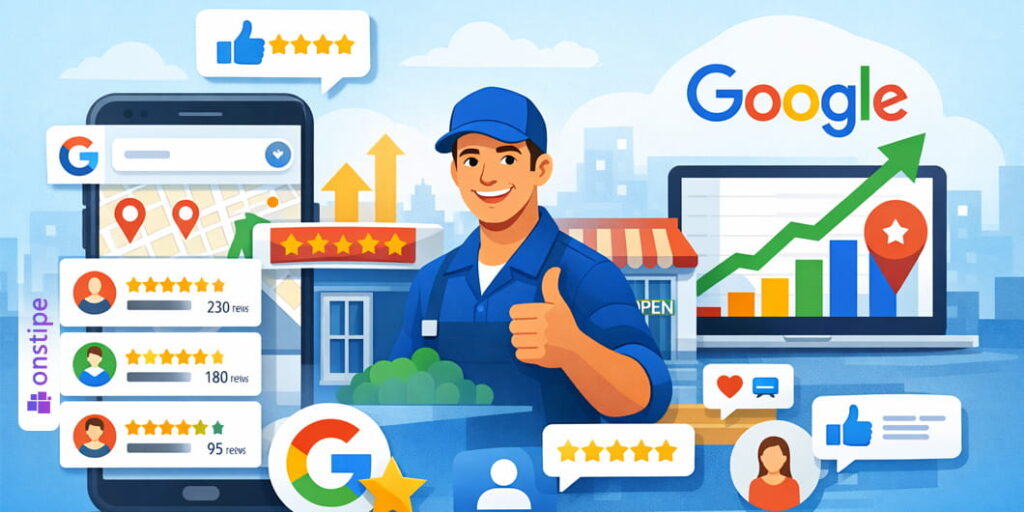
Local service businesses don’t compete on the internet the same way e-commerce stores or SaaS companies do. They compete in a hyper-local environment where trust matters more than traffic. A plumber, dentist, electrician, or repair technician is chosen not because of a clever headline — but because customers feel confident calling them.
That confidence is built through social proof.
Today, Google’s local algorithm increasingly prioritizes signals that mirror real-world reputation. Reviews, ratings, engagement, mentions, and user behavior now influence rankings almost as much as traditional SEO factors like keywords and backlinks.
In simple terms:
Google wants to rank businesses that people trust.
What Is Social Proof in Local SEO?
Social proof is any public signal showing that real customers value your business. Search engines interpret these signals as credibility indicators.
Common forms include:
- Google reviews and star ratings
- Customer testimonials
- Photos uploaded by customers
- Check-ins and local mentions
- Click behavior and dwell time
- Branded searches (people searching your business name)
- Engagement on Google Business Profile (calls, directions, bookings)
Google measures these signals to answer one question:
If a user clicks this business, will they likely have a good experience?
If the answer appears “yes,” rankings improve.
Why Google Cares About Social Proof
Google’s main goal is user satisfaction — not just relevance.
Years ago, ranking locally meant adding keywords like “best plumber near me.” Now Google uses behavioral data to validate whether a business truly deserves that ranking.
For example:
| Scenario | Google Interpretation |
| High rankings but no reviews | Possibly low trust |
| Many reviews, but low engagement | Weak popularity |
| High engagement + strong reviews | Reliable business |
This shift means local SEO is no longer purely technical — it is reputation-driven.
Google Reviews: The Strongest Ranking Signal
Reviews are the most powerful form of social proof for local businesses. They influence three ranking factors simultaneously:
1. Relevance
Reviews often contain keywords naturally written by customers:
“Fast AC repair in Surat”
“Emergency electrician came in 30 minutes.”
Google extracts contextual meaning from these phrases.
2. Distance
Google compares review locations to searchers. Businesses reviewed by nearby customers rank higher for nearby searches.
3. Prominence
Businesses with more reviews appear more popular and authoritative.
What Matters More — Rating or Quantity?
Both matter, but quantity wins in the long term.
A business with 4.4 stars and 350 reviews usually outranks
a business with 5 stars and 12 reviews.
Google trusts patterns over perfection.
Behavioral Signals: The Hidden Social Proof
Most businesses think social proof is only reviews — but user behavior is equally important.
Google tracks:
- Click-through rate (CTR)
- Calls from Google listing
- Direction requests
- Website visits
- Time spent on site
- Return visits
If users frequently choose your listing and interact with it, Google interprets it as a preferred option.
This is why improving reputation often boosts rankings without any technical SEO changes.
Photos and User-Generated Content
Customer-uploaded images dramatically influence local rankings.
They:
- Increase profile activity
- Improve user trust
- Extend dwell time
- Encourage more clicks
Google prioritizes listings with frequent real-world interaction because they signal active businesses.
A listing with 150 real customer photos often outranks a listing with perfectly designed stock images.
Authenticity > aesthetics.
Local Mentions and Brand Searches
When people search your business name directly, Google recognizes brand authority.
Examples:
- “Raj Cooling Surat reviews”
- “Best electrician Sharma services”
- “ABC plumbing contact number”
These branded searches act like backlinks for local SEO.
They confirm that people already know your business.
Social proof creates brand recall → brand recall creates searches → searches improve rankings.
The Feedback Loop That Drives Local Rankings
Social proof works as a self-reinforcing cycle:
- Customers leave reviews
- Rankings improve
- More people find the business
- More customers visit
- More reviews appear
- Authority grows
Businesses that understand this loop have dominated local search for years.
Website Trust Signals Also Affect Rankings
Google does not rely only on Google Business Profile data. It cross-checks your website.
Important on-site social proof signals:
- Testimonials
- Case studies
- Before-after photos
- Service area mentions
- Embedded Google reviews
- FAQ pages answering real customer questions
Local SEO today blends reputation marketing and optimization. For example, contractors investing in hvac seo services often see ranking improvements after adding customer proof sections because they reduce user hesitation and increase engagement metrics.
Shorter hesitation → longer visits → better rankings.
Response Behavior Matters
Google evaluates not only reviews but also how businesses respond to them.
Responding to reviews:
- Shows activity
- Confirms legitimacy
- Builds trust signals
- Improves engagement
Businesses replying to reviews typically rank higher than silent competitors.
Even a simple reply works:
“Thank you! Glad we could fix your AC quickly.”
It signals the business is real and active.
Negative Reviews Can Help Rankings
Counterintuitive but true — a few negative reviews help credibility.
A perfect 5.0 rating can look artificial.
A mix of 4-star and 5-star reviews appears genuine.
Google prefers authenticity over perfection.
What matters is response quality. A professional response to a complaint improves trust more than no complaint at all.
How Social Proof Impacts the Local Pack
The “Local Pack” (top 3 map results) heavily depends on trust signals.
To enter it, businesses usually need:
- Consistent new reviews
- High interaction rates
- Active listing engagement
- Location relevance
Traditional SEO can get you indexed — but social proof gets you chosen.
Google’s algorithm is now behavior-based, not keyword-based.
Practical Steps to Improve Social Proof
Ask for Reviews Immediately
Send a message after service completion — timing matters more than wording.
Encourage Photo Uploads
Customers trust real images more than logos.
Respond to Every Review
Even emojis and short replies help.
Add Reviews to Your Website
Increases dwell time and conversion rate.
Focus on Experience First
Better service = easier SEO.
The Future of Local SEO
Google is evolving toward a recommendation engine rather than a search engine.
Instead of asking:
“Who optimized best?”
Google asks:
“Who do users prefer?”
Social proof answers that question.
Businesses that prioritize customer experience and visibility of that experience will dominate rankings — regardless of how strong competitors’ technical SEO may be.
Conclusion
Local search rankings are no longer controlled purely by keywords, backlinks, or citations. They are shaped by reputation, engagement, and public validation.
Social proof acts as Google’s trust detector.
– Reviews tell Google people liked you.
– Clicks tell Google people chose you.
– Engagement tells Google that people stayed with you.
When these signals align, rankings naturally rise.
The future of local SEO belongs to businesses that treat every customer interaction as a ranking factor — because, today, it truly is.