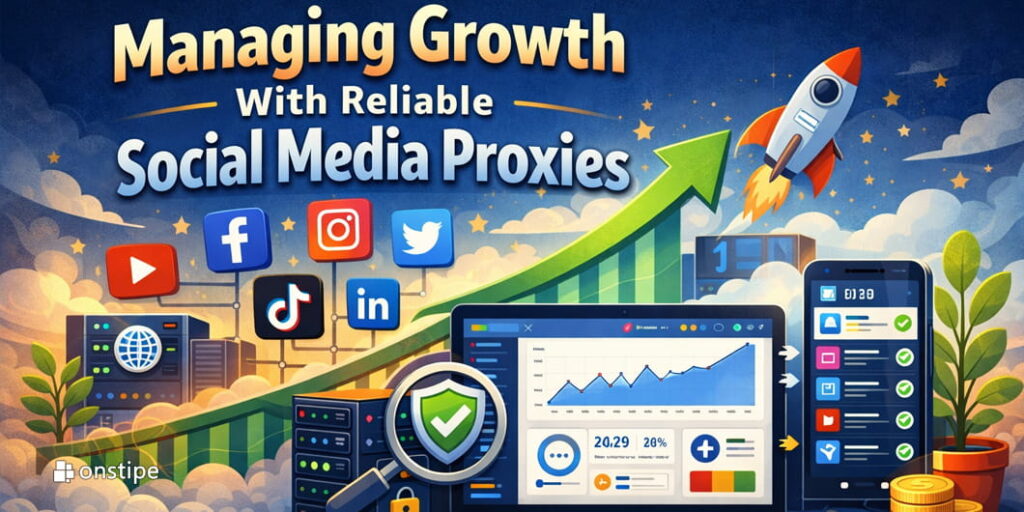
Social media is the life and death of brands. However, attempting to run ten Instagram accounts on one office Wi-Fi is not a good idea. You may be subject to short-term limitations. This activity is identified as suspicious behavior. This is why social media proxies are standard equipment for modern marketing teams. They act as intermediaries. They isolate your connection with the server of the platform.
With the appropriate configuration, you can have several work profiles without activating security algorithms. It’s about operating at scale. An IP address with twenty accounts appears to be a bot farm. Twenty IPs with twenty accounts appear as twenty different users.
Why Marketers Need Social Media Proxies
Efficiency drives profit. Marketing teams cannot afford to manually log in and out of logins. You must have the resources to support the load. However, automation tools make requests much quicker than a human being.
Facebook and TikTok have hard rate limits. When you go beyond them, you are blocked. Social media proxies distribute these requests across different IP addresses. This keeps your activity out of the reach of aggressive spam filters.
The Scale of the Challenge
Why are platforms so strict? Bad bots are a huge issue. Bad bots (automated threats) produce approximately 37% of all internet traffic. Social networks retaliate through excessive filtering. The actual users are caught in the crossfire. Legitimate brands are deprived of access to ad dashboards just because their office IP made too many requests. This is a disaster of operations that is averted by the use of intermediaries.
Types of Connection Tools
Not all IPs are equal. Instagram is not a good idea to use a datacenter server. These bulk IPs are easily identified by networks. You must have an IP that appears to be a real device.
The following is a list of the options that we have tried:
Residential Proxies
These are the IP addresses that are given to actual homeowners by Internet Service Providers (ISPs). They are the benchmarks of trust. With residential IPs, the platform will interpret a connection as a typical home network. They are harder to detect. They are also more expensive.
Mobile Proxies
These utilize cellular network IP addresses (4G/5G). They are highly trusted. Social media anticipates that mobile IPs will vary with the movement of users between cell towers. This dynamism renders mobile IPs highly efficient in the management of mobile-first applications such as TikTok and Instagram.
ISP Proxies
These are a combination of the speed of datacenter IPs and the trust of residential IPs. They are hosted in data centers but registered as residential.
| Type | Trust Score | Speed | Best Use Case |
| Datacenter | Low | High | Scraping public info |
| Residential | High | Medium | Profile management |
| Mobile | Very High | Medium | Instagram/TikTok growth |
| ISP | High | High | Ad verification, shop management |
Choosing a Social Media Proxy for Your Stack
You have to fit the tool to the task. Scraping hashtag data? High-speed datacenter IP could be effective. Are you running a social media automation script to schedule posts for clients? You need something stronger.
Long-term accounts are usually best served by using static IPs. You desire the same IP to be linked with the same login across time. This simulates the behavior of a normal user. Identity checks can be caused by frequent changes.
A Proxy-Seller ISP proxy may be considered if you require high speed to perform such tasks as coping limited-edition drops or handling heavy ad traffic. These provide the bandwidth of a commercial server with the static stability that brands require.
Technical Best Practices
Do not simply purchase a list of IPs and feed them into a bot. You need a strategy.
Use Multi-Account Management Browsers
Normal browsers are information leakers. They disclose your type of device, screen resolution, and fonts. This creates a “fingerprint.” Even with twenty logins with the same fingerprint, you will not be saved by gateways. Install anti-detect browsers on your servers.
Implement IP Rotation
You do not want to use the same IP consecutively when collecting data. IP rotation automatically switches your address after every request or set time period. This is necessary to scrap the audience insights without being blocked. In the case of rotating proxies, diversity is desired, not consistency.
Watch Your Headers
A high-quality social media proxy should strip away headers that reveal you are using an intermediary. Transparent servers identify the target network with the exact information about who you are. Elite tools conceal this fact entirely.
The Role of Anti-Detection Techniques
Social media proxies handle the connection layer. But the networks also examine behavioral patterns. Anti-detection goes beyond just swapping IPs. They include imitating human pauses, scrolling patterns, and sleep cycles.
Tools that will blast 1,000 likes in a minute will be banned, no matter the quality of the IP. We have witnessed marketers accuse their provider when it was their aggressive settings that were the problem.
Some managers worry about online privacy regarding their own data. Although it is crucial, the main concern here is the security of the asset (the social account) and not the personal identity of the user.
Cost Analysis and ROI
Quality costs money. Freebies can be very risky. They steal information or place advertisements. To a business, they are a liability.
- Mobile 4G/5G: May cost between $60 and $100 per month per port.
- Residential GBs: Typically billed per bandwidth, approximately $10-15 per GB.
- ISP Static: Typically $2-5/IP/month.
Think about the price of losing a confirmed business manager profile. It could cost thousands in lost revenue. Spending $50 a month on proper account management tools and clean IPs is a cheap insurance policy.
Final Thoughts on Scaling
The digital world is crowded. To be different, one needs volume and consistency. Proxies for social media are the infrastructure that makes this possible. They enable the agencies to manage fifty clients without purchasing fifty phones.
Check your current setup. Are you using a single IP on too many profiles? Repair it before the platform compels you to quit. Start with a small set of high-trust residential or mobile IPs. Monitor your success rates. When your foundation is stable, then scale up.