If you run a small business and feel like your social media is going nowhere, you are not alone. You are posting regularly, using the right hashtags, and maybe even investing in content creation. Yet the results are underwhelming at best. The followers are not coming, engagement is flat, and you are quietly starting to wonder if social media even works for businesses like yours.
Here is the truth: the problem is rarely what most business owners think it is.

Image Source : https://unsplash.com/photos/a-group-of-different-social-media-logos-HBkpnDVc_Ic
The Common Assumption (And Why It Is Wrong)
Most small business owners believe their social media struggles come down to two things: not having enough time or not having enough budget. These are real constraints, no doubt. But they are symptoms, not the root cause.
Only 55% of small businesses have a dedicated social media strategy document in place. That means nearly half of all small businesses are posting content without any structured plan behind it. No strategy means no direction, and no direction means inconsistent results regardless of how much time or money you throw at it.
The real problem is not resources. It is the absence of a clear, executable strategy built around your specific audience and goals.
Mistake 1: Treating All Platforms the Same
One of the biggest social media mistakes small businesses make is trying to be everywhere at once while doing the same thing on every platform. What works on LinkedIn will not work on Instagram. What performs well on TikTok will fall flat on Facebook.
Facebook remains the top social channel for most small businesses, used by 76% of them, followed by Instagram at 63% and LinkedIn at 43%. Each of these platforms has a different audience, a different content format, and a completely different algorithm. Spreading yourself thin across all of them without tailoring your approach is one of the fastest ways to burn out with nothing to show for it.
The fix is simple but requires discipline: pick two platforms where your target audience actually spends time and commit to mastering those first.
Mistake 2: Posting Without Purpose
There is a huge difference between being active on social media and being effective on social media. Many small businesses fall into the trap of posting just to stay visible, without thinking about what action they want their audience to take.
Algorithm changes negatively affect the organic reach of 62% of small businesses. This means that random, unplanned content is getting even less visibility than before. Every post you publish needs a purpose, whether that is driving traffic, building trust, generating inquiries, or growing your community.
Ask yourself before every post: what do I want the reader to do after seeing this? If you cannot answer that clearly, the post probably should not go live.
Mistake 3: Inconsistency Kills Your Social Media Strategy
Consistency is one of the most underrated factors in social media success. It is not about posting every single day. It is about showing up regularly enough that your audience begins to recognize and trust your brand.
More than half of small businesses admit struggling to keep their content fresh and stay up to date with social media trends. When content dries up or becomes repetitive, audiences disengage. The algorithm notices too. Platforms reward accounts that post consistently and punish those that go quiet for long stretches.
Creating a simple content calendar, even just planning two weeks ahead, can make a dramatic difference in how consistently your brand shows up online.
Mistake 4: Ignoring the Power of User-Generated Content

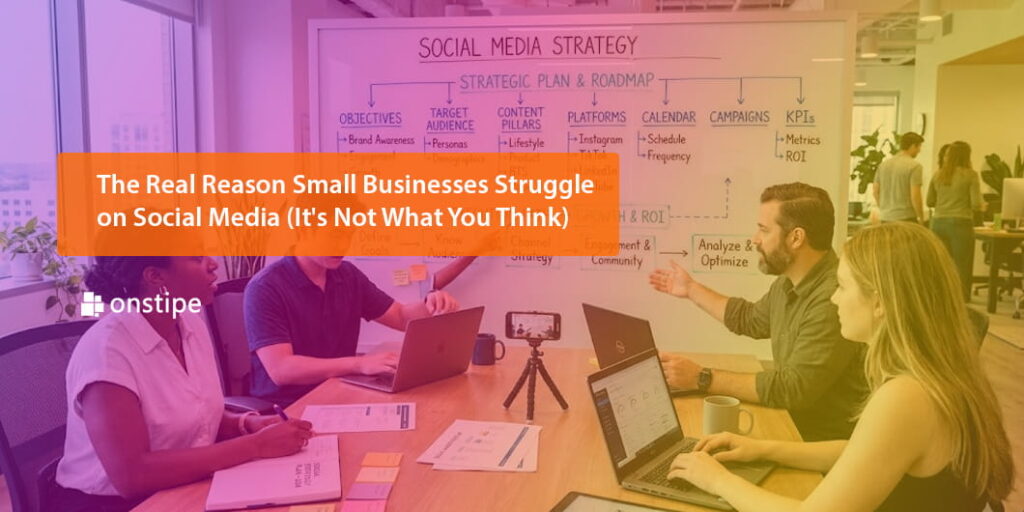
Image Source: https://unsplash.com/photos/a-group-of-people-sitting-around-a-table-with-laptops-iHzrww0uC44
Small businesses often overlook one of their most powerful free resources: content created by their own customers. User-generated content, or UGC, is authentic, relatable, and trusted far more than polished brand content.
When customers tag your business, share a photo of your product, or leave a glowing comment, that is content gold. Displaying this content on your website or social profiles through tools like social media aggregators helps you build social proof without having to create everything from scratch. It also keeps your feed active and varied without burning out your internal team.
Mistake 5: Measuring the Wrong Things
Vanity metrics are the enemy of real growth. Many small business owners celebrate high follower counts or big like numbers without asking whether those metrics are actually connected to revenue or leads.
Measuring ROI challenges 54% of small business owners. If you do not know which posts are driving website visits, form submissions, or purchases, you cannot improve. Setting up basic tracking through platform analytics and tools like Google Analytics gives you the data you need to double down on what actually works.
Focus on metrics that tie directly to your business goals: website clicks, lead form submissions, direct message inquiries, and conversion rates.
The Fix Most Small Businesses Overlook: Dedicated Expertise
Here is where the conversation gets honest. Even if you fix your strategy, your content calendar, your platform focus, and your analytics setup, executing all of that consistently while also running a business is genuinely hard. Most small business owners simply do not have the bandwidth.
This is why many growing businesses are now turning to Wing Assistant and looking for a dedicated social media manager for hire rather than continuing to juggle it themselves. A skilled social media manager does not just post content. They build and execute a strategy, monitor trends, engage with your audience, and report on results. They bring the expertise and consistency that most in-house, wearing-many-hats teams cannot sustain.
43% of small businesses struggle with consistent content creation and 56% face time management issues with social media. Bringing in dedicated expertise directly addresses both of these problems at once.
What a Strong Social Media Presence Actually Looks Like
The small businesses winning on social media today are not necessarily the ones with the biggest budgets. They are the ones with clear positioning, a consistent voice, content that speaks directly to their audience, and systems in place to keep it all running without relying on inspiration or spare time.
Small businesses leveraging social media are more likely to see growth in sales, profits, and staffing, with 75% of those using it effectively expanding their workforce between 2021 and 2022. Social media, when done right, is one of the highest-return channels available to a small business. The key phrase is: when done right.
Final Thoughts
The real reason most small businesses struggle on social media is not a lack of time, money, or creativity. It is the lack of a structured strategy paired with consistent, purposeful execution. Fix the foundation, measure what matters, leverage your customers’ voices, and do not be afraid to bring in the right expertise when your growth demands it.
Think of your social media presence the way you think about your storefront. You would not leave it unmanned, disorganized, or without a clear message to visitors. Your social profiles deserve that same level of intention and care. A business that shows up consistently, speaks directly to its audience, and engages authentically will always outperform one that simply posts more.
Social media is not a shortcut to success. But with the right approach, it is absolutely one of the most powerful tools a small business has.