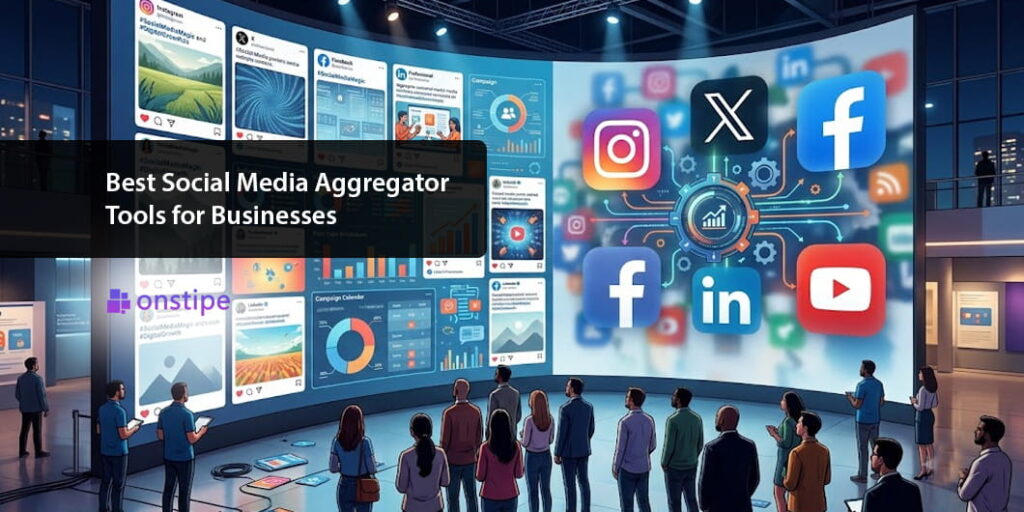
Social media has become the most visible face of a business. Customers discover brands on Instagram, follow updates on Facebook, watch videos on YouTube, and share their experiences across multiple platforms. The challenge? Your audience is everywhere, while your website usually has only one place to tell your story.
A social media aggregator collects content from different social networks and brings it together in one place. Businesses can display posts, reviews, hashtags, and other user-generated content on their websites, screens, events, or as a social walls.
But with so many platforms available today, finding the best social media aggregator for your business can feel overwhelming. So, let’s look at some popular tools and what makes each one useful.
What Is a Social Media Aggregator?
Instead of asking visitors to jump from Instagram to Facebook and then to YouTube, you can bring selected content into a single, engaging display. A good tool can automatically collect posts using social profiles, hashtags, handles, keywords, or other content sources.
For example, a restaurant could display customer Instagram posts on its website. A university could showcase student content during an event. An e-commerce brand could feature customer photos alongside its products.
Why Do Businesses Need Social Media Aggregator Tools?
Managing several social channels manually takes time. More importantly, social content can be incredibly valuable but often remains locked inside individual platforms.
A social media aggregator helps businesses:
- Get content from multiple platforms into one social wall.
- Keep website content fresh automatically.
- Showcase authentic customer experiences.
- Increase engagement with social content.
- Build social proof through user-generated content.
- Create attractive displays for events and physical spaces.
- Reduce the need to constantly update website content manually.
The biggest advantage is authenticity. A polished marketing message tells people what a brand wants them to know. A customer’s real post shows people what the brand experience actually looks like.
Best Social Media Aggregator Tools for Businesses
1. Walls.io
Walls.io is another popular social media aggregation platform focused heavily on creating social walls. It allows businesses and event organizers to collect content from social networks and display it in a centralized feed.
For conferences, exhibitions, product launches, and community events, this can turn social media activity into part of the physical experience.
2. Onstipe
Onstipe is designed for social media aggregation and user-generated content. Businesses can collect social posts from different networks, customize their appearance, moderate content, and embed feeds on websites or display screens.
Its social wall software capabilities can also be useful for conferences, events, retail locations, and campaigns where brands want to display real-time social content.
3. Juicer
Juicer is a social media feed aggregator that collects posts from multiple social platforms into a single feed.
Businesses can customize how content looks while maintaining a relatively simple workflow.
It can be useful for brands that want their social activity to remain visible on their website without manually copying and pasting individual posts.
4. Curator
Curator supports social feeds from several major networks and provides customization options for how the content appears.
For smaller businesses and marketing teams, the appeal is straightforward: create a feed once and allow it to update as new social content becomes available.
This can be particularly helpful for websites where fresh content improves the overall user experience.
5. Flockler
Flockler is built for organizations that want to display social media content across websites, digital signage, and other screens.
Its use cases extend beyond traditional website feeds. Brands can create displays for offices, stores, stadiums, campuses, and events.
For organizations managing multiple physical and digital touchpoints, this makes Flockler worth considering when evaluating social media aggregation solutions.
How to Choose the Best Social Media Aggregator
Start with social network support. Make sure the platform supports the channels your audience actually uses.
Moderation is equally important, especially when you’re displaying user-generated content. You should have control over what content appears publicly.
Then look at analytics. If social content is an important part of your marketing strategy, understanding impressions, engagement, clicks, and other performance indicators can help you determine whether the feed is doing its job.
Finally, consider publishing options. A business may need a website widget today but digital signage or event displays tomorrow. Choosing a flexible platform can prevent the need to switch tools later.
Social Media Aggregation Is About More Than Feeds
The real value of a social media aggregator isn’t simply putting Instagram, Facebook, or YouTube posts on a webpage.
It is about turning scattered social activity into a recognizable brand experience.
Imagine visiting a hotel website and seeing recent guest photos. Or entering a fashion store and seeing customer posts displayed on a digital screen. Or attending a conference where posts from attendees appear live throughout the venue.
In each case, social content becomes part of the experience rather than something that exists separately on another platform.
That is why social wall software has become useful for more than social media marketing teams. Events, retailers, universities, restaurants, hospitality businesses, and corporate organizations can all use aggregated content to create more interactive experiences.
Final Thoughts
Choosing the best social media aggregator isn’t really about finding the tool with the longest feature list. It’s about finding the platform that fits your goals, audience, content sources, budget, and publishing needs.
Tools such as Onstipe, Walls.io, Juicer, Curator, and Flockler offer different approaches to social media aggregation. Before choosing one, think about where you want to display your content, which networks you need, how much moderation you require, and whether analytics matter to your team. It can bring customer voices into your brand story, strengthen social proof, and create a more engaging experience for visitors.
In a world where customers increasingly trust experiences shared by other customers, bringing those conversations into your digital and physical spaces can be a smart way to make your brand feel more human.