Social media has become one of the most powerful ways for brands to connect with their audiences. Every day, customers share photos, videos, reviews, opinions, and experiences across platforms such as Instagram, Facebook, X, YouTube, TikTok, and LinkedIn. The challenge for businesses is not collecting this content—it is bringing it together, organizing it, and displaying it in a meaningful way.
A social media aggregator API enables websites, applications, digital platforms, and other products to fetch social content from multiple sources and integrate it into their own interfaces. Instead of asking visitors to move from one platform to another, businesses can bring relevant social content directly into their website, app, event screen, or digital experience. From displaying customer posts to creating live social walls, the possibilities are extensive.
What Is a Social Media Aggregator API?
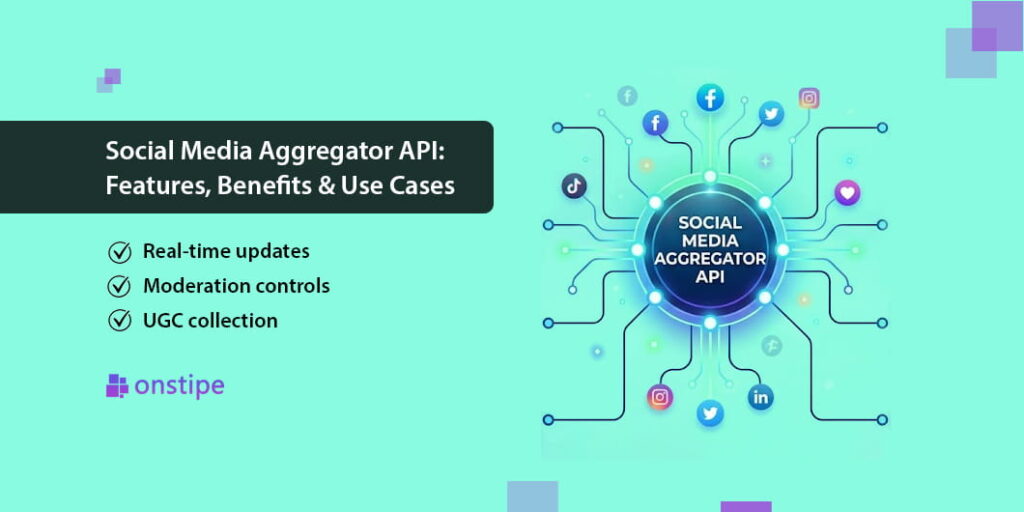
A social media aggregator API is programmable tools that allows developers to collect and manage content from different social media platforms and display it on another digital screen or website.
For example, imagine an apparel brand running a campaign around a new collection. Customers post pictures wearing the collection on Instagram using a campaign hashtag. This is more than simply embedding a social post.
The API can become a bridge between social platforms and a brand’s digital ecosystem, enabling developers to retrieve content, apply filters, moderate posts, and customize how that content is presented.
In many cases, a social media API provided by an individual platform is limited to that platform’s available data and permissions. An aggregator can simplify the process of working with multiple networks through a more centralized integration.
Key Features of a Social Media Aggregator API
A good API should do more than simply collect posts. It should give developers control over how social content is discovered, processed, and delivered.
1. Multi-platform content aggregation
The most important advantage is the ability to collect content from multiple social networks through a uniform integration. Depending on the provider and available platform permissions, businesses can work with text, images, videos, hashtags, mentions, profiles, and other forms of social content. This reduces the need to build and maintain separate integrations for every platform.
2. Real-time or near-real-time updates
Social content moves quickly. A delayed feed can make a campaign feel outdated. An effective API can provide frequent content updates so websites and applications can display fresh posts without requiring developers to manually refresh or upload content. This is particularly useful for live events, conferences, product launches, and campaigns.
3. Content filtering
Not every social post belongs on a brand’s website. Filtering tools can help businesses organize content based on hashtags, keywords, accounts, locations, content types, or other available criteria. This makes it easier to create focused feeds instead of displaying an overwhelming stream of unrelated posts.
4. Moderation controls
User-generated content can be incredibly valuable, but brands usually want to review it before publishing. Moderation features can allow teams to approve, reject, hide, or manage individual posts. This is particularly important for brands running public campaigns or displaying content in highly visible locations.
5. Customizable content delivery
Developers may want social content in different formats depending on the application. An API can provide structured data that can be transformed into a website widget, mobile application feed, digital signage display, or custom interface. This flexibility is one reason APIs are more useful for developers than traditional social widgets.
6. UGC collection
A UGC API can help businesses collect and manage user-generated content from social channels and other connected sources. UGC—short for user-generated content—includes customer photos, videos, reviews, testimonials, and other content created by real users. When incorporated responsibly, this content can make digital experiences feel more authentic and community-driven.
Benefits of Using a Social Media Aggregator API
The value of an aggregator isn’t limited to technical convenience. Building individual integrations for every social platform can require significant development and maintenance work. A centralized API can simplify the architecture and reduce repetitive integration tasks. Developers can focus more on the experience they are building instead of maintaining multiple independent data pipelines.
Static websites can sometimes struggle to communicate what customers are saying about a brand right now. Adding social content introduces fresh, constantly changing material. A fashion website might show customer styling photos, while a university could display student experiences and campus events.
People naturally look for evidence that others have used and enjoyed a product or service. Customer-generated posts can provide a form of social proof because visitors see real people interacting with a brand. When properly moderated and presented with appropriate permissions, this content can complement traditional product descriptions and marketing messages.
A single piece of social content doesn’t necessarily need to remain on the original platform. With the right integration, approved content can potentially appear across websites, mobile apps, digital displays, event screens, and other brand touchpoints. This creates more value from content that customers are already creating.
Social Media Aggregator API vs. Social Wall API
The terms can sometimes be used interchangeably, but they often describe different layers of the same ecosystem.
A social wall API is generally focused on powering a social wall or social-content display. For example, an event organizer might use it to show attendee posts on a large screen during a conference.
A social media aggregator API is broader. It can collect and organize social content and make that data available for different applications, including social walls.
In simple terms, an aggregator can be the data layer, while a social wall can be one of the experiences built on top of that data.
Popular Use Cases
Events and conferences
Event organizers can collect posts using event hashtags and display selected content on venue screens. This can encourage attendees to participate while creating a live digital record of the event.
E-commerce websites
Online stores can showcase customer photos alongside products. Seeing products in real-world situations can provide visitors with additional context beyond professionally produced product photography.
Marketing campaigns
Brands can create hashtag campaigns and bring approved submissions into campaign landing pages. A social feed integration can keep the page updated as new content arrives.
Hospitality and travel
Hotels, resorts, and tourism companies can display guest photos and experiences across websites or digital displays, helping prospective visitors discover experiences from actual travelers.
Digital signage
Retail stores, airports, universities, stadiums, and corporate offices can use social feeds on digital screens to create more dynamic displays.
Mobile applications
Developers can incorporate social content into apps without requiring users to leave the application to find relevant conversations or community content.
How to Choose the Right API
Before selecting a provider, businesses should consider several practical factors. Look at the platforms supported, API documentation, authentication methods, rate limits, content refresh frequency, moderation capabilities, analytics, scalability, and pricing. It is also important to understand each social network’s current API policies and data-access requirements.
Businesses should ensure that their implementation respects platform rules, user privacy, content rights, and applicable regulations.
Final Thoughts
A social media aggregator API can turn scattered social content into a useful part of a brand’s digital experience. Instead of keeping customer conversations isolated on individual platforms, businesses can bring relevant content into websites, applications, campaigns, events, and digital displays.
Whether the goal is to create a live social wall, showcase customer content, build a social feed integration, or develop a completely custom application, the right API provides the underlying infrastructure to make social content more accessible and useful.
The real opportunity isn’t simply collecting more social posts. It’s about turning authentic conversations and user-generated experiences into meaningful digital experiences—while giving developers the flexibility and control needed to build them well.