
When someone lands on your website for the first time, one question is usually running through their mind: “Can I trust this business?”
Your website can have a great design, persuasive copy, and an impressive list of products or services, but trust often comes from something much simpler—what other customers have to say.
That is why testimonials and online reviews have become such an important part of modern websites. But there is a growing difference between displaying hand-picked testimonials and showing authentic reviews directly from platforms like Google.
So, which builds more trust: traditional testimonials or a Google review widget for website visitors?
However, when authenticity, freshness, and transparency matter, displaying real Google reviews can offer some significant advantages.
What Are Traditional Testimonials?
Traditional testimonials are quotes or reviews collected directly from your customers and published on your website.
These testimonials can be valuable because they allow businesses to highlight specific experiences and present them in a carefully designed format.
The problem is that website visitors know these testimonials have been selected and published by the business itself.
Since businesses generally choose which testimonials to display, visitors have little visibility into the reviews that were not selected.
What Is a Google Review Widget?
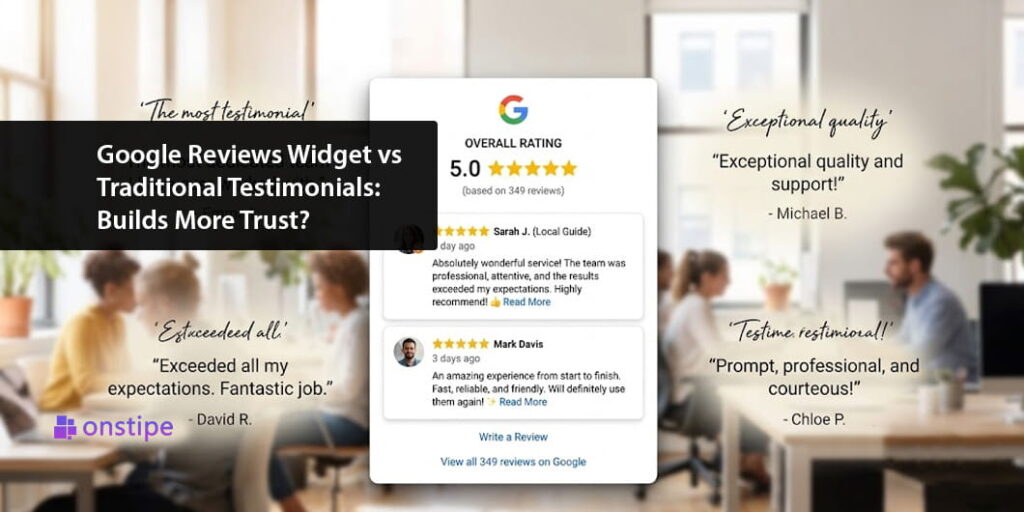
A Google review widget for website is a tool that displays reviews from a business’s Google profile directly on its website.
Instead of manually copying individual reviews, the widget can pull reviews from Google and display them in a customizable layout.
Depending on the tool, you may be able to show:
- Customer names and profile photos
- Star ratings
- Review dates
- Review text
- Overall Google rating
This makes a customer review widget more than just a collection of quotes. It creates a visible connection between your website and an external review platform where customers can independently share their experiences.
Why Authenticity Matters
The biggest difference between traditional testimonials and Google reviews is the perception of authenticity.
A testimonial on your website may be genuine, but visitors don’t necessarily know where it came from.
Google reviews, on the other hand, are associated with a recognizable third-party platform. Visitors can potentially click through and see the broader collection of reviews rather than relying solely on the handful of comments selected by the business.
This distinction can make a difference.
The other displays hundreds of Google reviews, complete with star ratings, dates, customer names, and a link to the business’s Google profile.
Fresh Content Creates Stronger Social Proof
Another limitation of traditional testimonials is that they can remain on a website for years.
A testimonial written three years ago may still be perfectly valid, but a visitor has no way of knowing whether the business continues to provide the same level of service today.
A review aggregator can help solve this problem by bringing reviews from external platforms into one place and displaying newer customer feedback.
Fresh reviews make your website feel active and can show potential customers that people are still buying from, visiting, or working with your business.
Google Reviews Embed: A More Transparent Approach
A Google reviews embed can make your website’s social proof more credible because it doesn’t rely entirely on content created and controlled by the business.
Visitors can see information such as the reviewer’s name, rating, and date. Depending on the implementation, they may also be able to visit the original review source.
This creates a stronger sense of connection between the website and the customer’s actual experience.
Of course, embedding reviews doesn’t guarantee that every visitor will trust your business. Reviews still need to be genuine, relevant, and presented clearly.
Are Traditional Testimonials Still Useful?
Absolutely.
Traditional testimonials have one major advantage: control over context.
For example, a software company may want to feature a detailed testimonial from a customer explaining how its product helped reduce administrative work.
The longer testimonial can tell a much more complete story.
Traditional testimonials are also useful for highlighting specific customer segments. You might have separate testimonials from an enterprise customer, a small business owner, and an individual consumer.
So, rather than treating testimonials as outdated, it’s better to think of them as complementary to external reviews.
The Best Strategy: Use Both
If your website has enough space, why choose one?
Combining both approaches can create a stronger trust-building experience.
For example, your homepage could begin with a few detailed customer success stories. Further down the page, you could add a customer review widget showing recent Google reviews.
This gives visitors both sides of the story.
The testimonials explain how your business helped specific customers.
How to Make Reviews More Trustworthy
Whatever format you choose, presentation matters.
First, don’t hide negative feedback completely. A website filled with nothing but perfect five-star comments can sometimes feel less believable.
Second, avoid editing reviews in a way that changes their meaning. Authenticity should always come first.
Finally, keep your reviews updated. Old social proof can lose some of its impact when visitors suspect that the content hasn’t been maintained.
Final Verdict
Traditional testimonials are excellent when you want to tell detailed customer stories and highlight specific results. A Google review widget, meanwhile, can provide a stronger sense of authenticity, transparency, and ongoing customer activity.
For most businesses, the smartest approach is not to replace one with the other.
Use testimonials to tell your best customer stories, and use a Google review widget for website visitors to show that those positive experiences aren’t isolated examples.
When potential customers can see real people, recent feedback, ratings, and a connection to an independent review platform, your website’s social proof becomes much more convincing.
Ultimately, trust isn’t created by simply adding more reviews to a page. It’s created by making the customer feedback feel real, current, transparent, and relevant.
And that’s where combining traditional testimonials with a well-designed Google reviews embed can make your website much more credible.