Your customers are talking about your brand on social media. They are sharing photos, posting reviews, creating videos, and recommending products to their followers. But are website visitors getting a chance to see those conversations? This is where a social media aggregator can make a real difference.
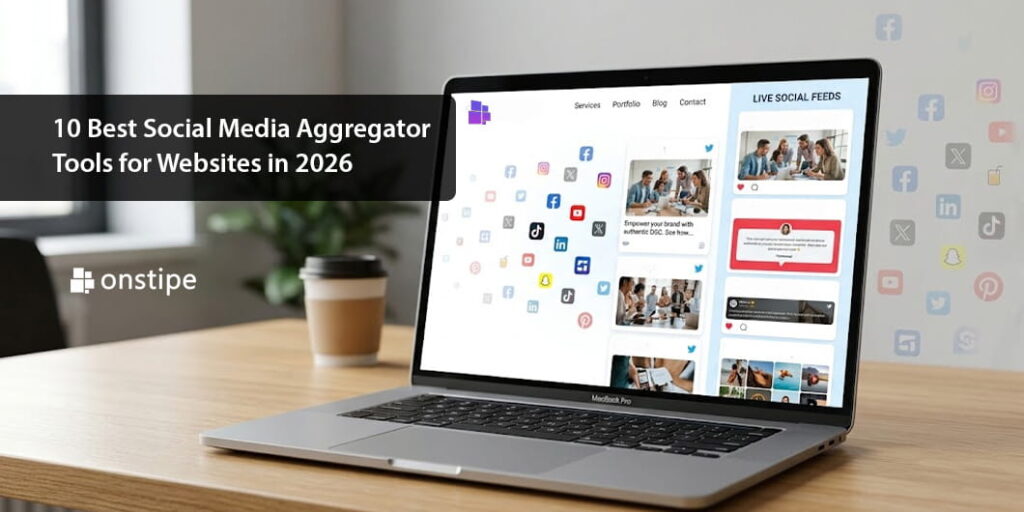
A social media aggregator collects content from different social media platforms and brings it together in one place. You can display this content on your website through an attractive social media feed, interactive social wall, or embedded widget. Instead of keeping your website and social profiles separate, you create a connected experience that helps visitors discover what people are saying about your brand.
In 2026, these tools are becoming increasingly useful for businesses that want to improve website engagement, showcase user-generated content (UGC), build customer trust, and support their marketing campaigns.
Some are designed for events, others focus on customer reviews, and some specialize in website integrations. To help you make the right choice, here are 10 of the best social media aggregator tools for websites in 2026.
1. Onstipe
Onstipe is a social media aggregator that helps businesses collect and display social media content through website feeds and social walls. It is particularly useful for brands and event organizers looking to turn audience interactions into engaging visual experiences.
With social content displayed directly on a website, businesses can showcase customer posts, campaign hashtags, and brand-related conversations in one place.
Key features:
- Social media content aggregation
- Customizable social walls and feeds
- Content moderation options
- Website embedding capabilities
- Social displays for events and digital screens
Best for: Businesses, event organizers, marketers, and brands that want to showcase social proof.
Why choose it? Onstipe is worth considering if you want to make your website more interactive while highlighting content created by your audience. It can also help event organizers encourage participation by displaying relevant social posts on shared screens.
2. Walls.io
Walls.io is designed around social walls that bring audience content together. It is especially relevant for conferences, exhibitions, corporate events, and community campaigns.
Key features:
- Interactive social walls
- Content moderation
- Customizable display layouts
- Website and screen integrations
- Event-focused features
Best for: Event organizers, conference planners, and businesses running hashtag campaigns.
Why choose it? A social wall can turn an event audience into active participants. Attendees can share content, while organizers display selected posts to create a more connected atmosphere.
3. Flockler
Flockler helps brands aggregate and display social media content across websites and other digital channels. It is suitable for businesses that want to incorporate social proof into their ongoing marketing activities.
Key features:
- Social media feed aggregation
- Multiple display layouts
- Content curation and moderation
- Website embedding
- UGC-focused displays
Best for: Established brands, educational institutions, publishers, and marketing teams.
Why choose it? Flockler is worth exploring if you want to curate social content for multiple campaigns or website pages while maintaining a consistent brand experience.
4. Juicer
Juicer combines content from connected social media accounts into a unified feed. Its straightforward approach makes it appealing to website owners who want to display social updates without building a custom solution.
Key features:
- Consolidated social feeds
- Website embedding
- Feed customization
- Content filtering options
- Support for multiple content sources, depending on the plan
Best for: Small businesses, bloggers, agencies, and website owners.
Why choose it? Juicer is a practical starting point if your primary goal is to bring social posts together and display them in a single location.
5. EmbedSocial
EmbedSocial offers website tools for displaying social media content, customer reviews, and other user-generated material. It is particularly relevant for businesses that want to combine visual social content with customer feedback.
Key features:
- Social media feed widgets
- Review collection and display tools
- Website integrations
- Customizable layouts
- UGC presentation features
Best for: Local businesses, service providers, ecommerce stores, and brands focused on customer trust.
Why choose it? Combining social posts with customer reviews can help visitors understand how real customers interact with your business before making a purchase or booking a service.
6. Curator.io
Curator.io provides a simple way to aggregate content from supported social media sources and embed it on a website. It is suitable for organizations that want a central feed featuring content from different social profiles.
Key features:
- Social media aggregation
- Website feed embedding
- Layout customization
- Content filtering
- Options for different website requirements
Best for: Small businesses, nonprofits, creators, and marketing agencies.
Why choose it? Curator.io is worth considering if you want a manageable solution for showcasing social updates without investing heavily in a complex content management system.
7. Elfsight
Elfsight offers a collection of website widgets, including social media feed widgets that display content from supported platforms. Its broader widget library makes it useful for website owners who want to add social content alongside other website features.
Key features:
- Social media feed widgets
- Ready-made templates
- Visual customization
- Website integration
- A broader collection of website widgets
Best for: Freelancers, small businesses, designers, and nontechnical website owners.
Why choose it? Elfsight is a convenient option if you want to add a social media feed without building a custom integration from scratch.
8. Smash Balloon
Smash Balloon is particularly popular among WordPress users who want to display social media content directly on their websites. Its platform-specific plugins provide a way to integrate supported social networks into WordPress websites.
Key features:
- WordPress social feed plugins
- Platform-specific feed options
- Customizable layouts
- Website-focused integrations
- Options for displaying social and visual content
Best for: WordPress bloggers, publishers, businesses, and WooCommerce store owners.
Why choose it? If your website runs on WordPress, Smash Balloon is worth considering because its dedicated plugins can make integration more convenient.
9. SociableKIT
SociableKIT offers embeddable widgets for displaying social media feeds and other online content on websites. It is designed to help businesses incorporate external content into their existing pages.
Key features:
- Embeddable social media widgets
- Support for various content sources
- Website-friendly integrations
- Customization options
- Multiple widget types
Best for: Small businesses, creators, agencies, and website developers.
Why choose it? SociableKIT is worth exploring if you need specific social feed widgets and want to integrate them into an existing website with minimal development work.
10. Sprout Social
Sprout social is an enterprise-grade social media management, management, and analytics platform. Unlike lightweight aggregators that only fetch and display content on websites, Sprout Social is built to help businesses monitor conversations, publish content, analyze performance, and manage customer service across all major social networks from a single dashboard.
Key features:
- Smart inbox
- Content aggregation
- Advance social listening
- Content moderation options
Best for: Conferences, exhibitions, brand activations, and event marketing teams.
Why choose it? A social wall can help businesses turn audience-generated content into part of the event experience, encouraging attendees to participate and engage with the brand.
How to Choose the Best Social Media Aggregator for Your Website
Choosing the right tool involves more than comparing feature lists. The best option should support your website platform, marketing goals, and audience.
1. Check Supported Social Networks
Identify which platforms matter most to your business. You might need Instagram photos, Facebook posts, YouTube videos, LinkedIn updates, or content from other networks. Always verify current integrations and permissions, as supported content types can vary.
2. Look for Customization Options
Your social media feed should match your website’s design. A consistent design helps the feed feel like a natural part of your website.
3. Prioritize Content Moderation
If your feed includes user-generated content, moderation is essential. Look for tools that give you review posts, filter unwanted content, and maintain a professional presentation.
4. Consider Website Performance
A social media widget should improve your website experience rather than slow it down. Look for responsive layouts, efficient loading, and compatibility with your website platform.
5. Compare Pricing and Scalability
Consider your current budget and future needs. Some tools offer basic free plans, while advanced moderation, additional feeds, analytics, or commercial features may require paid subscriptions. Compare the actual features included in each plan instead of relying only on advertised starting prices.
Conclusion
A social media aggregator can help your website become more engaging, authentic, and connected to your audience. By bringing social posts and customer experiences into one place, you can make your brand’s online presence more visible to people who are already interested in what you offer.
Tools such as Onstipe, Walls.io, Flockler, Juicer, EmbedSocial, Curator.io, Elfsight, Smash Balloon, SociableKIT, and Sprout Social each serve different website and marketing needs.
If you want to create event displays, prioritize social wall features. If your focus is ecommerce, explore tools that support customer content and product-focused experiences. For a simple WordPress feed, a dedicated plugin may be all you need.
Ultimately, the best social media aggregator is the one that fits your goals, works with your website, and makes it easier for visitors to connect with your brand. Start with your most important use case, compare your options carefully, and choose a solution that can grow alongside your business in 2026 and beyond.