Your annual conference takes eleven months to plan and lasts two days. Then it ends.
The banners come down, the badges go in a box, and the whole thing collapses into a photo album nobody opens and a survey with a 12% response rate.
That is an enormous amount of effort producing a very short return. The organizations getting the most out of events have stopped treating them as events at all. They treat them as content production, with the gathering itself as the shoot.
Here is how that pipeline works.
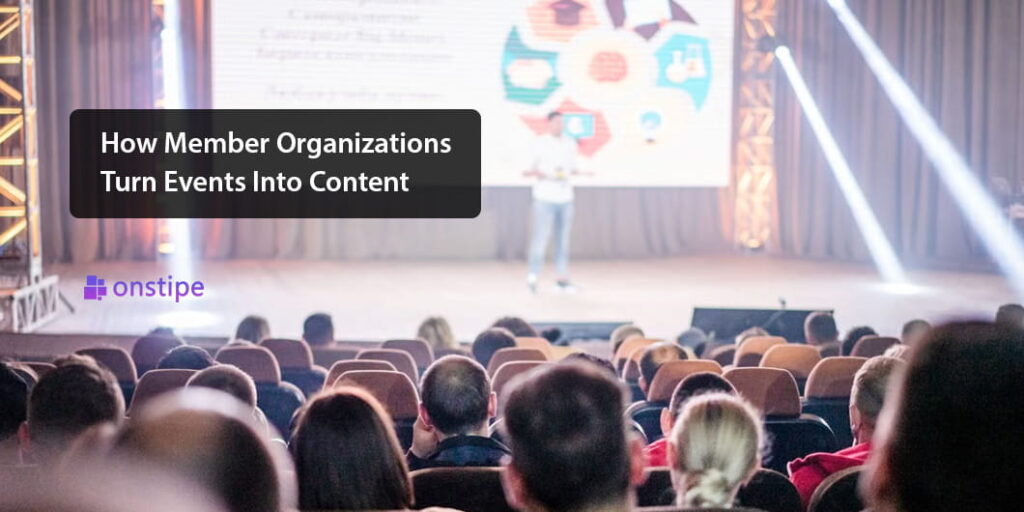
Photo by Atlantic Ambience: https://www.pexels.com/photo/people-sitting-inside-the-auditorium-9275222/
Why Events Alone Stopped Being Enough
First, the uncomfortable context, because this shift is not optional anymore.
Event attendance is softening. According to reporting from the American Society of Association Executives, 62% of associations reported stable or rising event attendance in 2023, and that figure fell to 53% by 2024. The same analysis notes that only 11% of associations describe their value proposition as very compelling.
The conclusion drawn there is blunt. Events remain essential, but they are no longer enough on their own, because members now expect a continuous experience rather than an annual one.
The retention numbers reinforce it. The Membership Marketing Benchmarking Report produced annually by Marketing General puts median association renewal around 84%, with first-year renewal notably lower.
Think about what that means for a member who joins in March for a conference in October. They have seven months of paying dues and receiving very little. Then two days of value. Then five more months of silence before renewal.
Content is what fills that gap. And your event is the cheapest place to produce it.
Where Membership Management Software Fits in the Pipeline
Before the creative part, the boring part, because this is where most organizations lose the thread.
Turning an event into content requires knowing who attended, what sessions they chose, who spoke, who volunteered, and how to reach each of them afterward. If that lives in a spreadsheet somebody exported once, the pipeline breaks immediately.
This is the practical case for running events through the same system that holds your membership records. A membership management tool like Wild Apricot ties event registration to member profiles directly, so attendance becomes part of the member record rather than a separate list.
That matters for content specifically. When your membership management software knows who was in the room, you can follow up with the twelve people who attended a particular workshop, feature them accurately, and tag the right members when you publish. Without it, you are guessing.
Phase One: Before the Event
Most organizations start creating content when the doors open. That is at least three weeks too late.
The pre-event phase is where you build the tag and teach people to use it. Pick one hashtag, keep it short, and put it everywhere: registration confirmations, calendar invites, the event page, the reminder emails.
Speaker announcements are content. So are behind-the-scenes preparation posts, agenda reveals, and short clips of presenters recording a fifteen-second introduction on their phone.
This phase does two jobs. It builds anticipation, and it establishes the tag before anyone arrives, which is the single biggest determinant of whether attendees actually use it.
Phase Two: During the Event
This is the harvest, and the goal is to make posting easier than not posting.
Put the hashtag on physical things people look at. Table tents, screens, the back of name badges, the bottom of every slide. Signage at eye level near queues works particularly well, because that is when people are on their phones anyway.
Create one obvious photo moment. A backdrop, a step-and-repeat, a good-looking corner with decent light. Attendees will photograph something. Deciding what makes it something branded.
Then display what comes in. A live social wall showing attendee posts on a screen in the lobby or between sessions creates a visible feedback loop. People see their own post appear on a big screen, and that small moment of recognition prompts others to post so theirs appears too.
Moderate it in real time, without exception. An open hashtag at a public event will collect noise, and a curated wall is the difference between a genuine asset and an embarrassment nobody can take down fast enough.
Phase Three: After the Event
Here is where most of the value actually sits, and where most organizations stop.
You now have a body of material you did not have to create: attendee photos, quotes, session takeaways, video clips, and reactions. Collected and organized, that is roughly a quarter of your content calendar for the following year.
Practical uses. Recap posts and highlight reels. Testimonials for next year’s registration page. Quotes for the newsletter. A social wall embedded on your website so prospective members can see what the event actually looked like rather than reading a description of it.
This is also where engagement measurement belongs. As Associations Now has covered, associations increasingly use engagement scoring, assigning weight to member actions to identify who is genuinely involved and who is drifting. Event attendance and content participation are exactly the sort of signals that feed that.
The credibility angle matters too. User-generated content is produced by participants rather than the organization, which is precisely why prospective members read it differently than they read marketing copy.
The Reframe Worth Making
Stop asking how the event went. Start asking what the event produced.
A two-day conference that yields a year of content, a set of authentic testimonials, and a measurable engagement signal on every attendee record is a fundamentally different investment than a two-day conference that yields a folder of photos.
The work required to make that shift is not enormous. It is a hashtag decided early, signage that makes it visible, a way to display what comes in, and a system that knows who was there.
Your members are already making content at your events. Most organizations simply never collect it.
That is the gap worth closing before your next one.